Friday, 18 January 2013

How many neutrinos in the sky?

Just before Christmas, the WMAP collaboration posted the 9-years update of their Cosmic Microwave Background results. Before going into details it's worth to stop for a second and admire the picture that I pasted here. Thanks to the observations of the WMAP satellite (black) and the terrestrial telescopes SPT (blue) and ACT (orange) we know the spectrum of the CMB fluctuations down to the scales of 0.1 degree. All these peaks and wiggles are predicted by the standard cosmological model, the so-called ΛCDM model (black line). In particular, the positions and the relative sizes of the peaks  provide the strongest argument to date for the existence of dark matter in the Universe: a non-relativistic matter component that, unlike baryons, does not interact with photons. At present, the alternatives to dark matter cannot even dream of quantitatively explaining the observed features of the CMB.  

That late in the game one would not expect any spectacular turns of the action. Indeed, compared to the 7-years WMAP data, the update typically brings a 20-30% reduction of already tiny errors on the composition of the Universe. There is however one number that changed visibly. The effective number of relativistic degrees of freedom at the time of CMB decoupling, the so-called Neff parameter, is now Neff = 3.26 ± 0.35, compared to Neff = 4.34 ± 0.87 quoted in the 7-years analysis.  For the fans and groupies of this observable it was like finding a lump of coal under the christmas tree...  

So, what is this mysterious Neff parameter? According to the standard cosmological model, at the temperatures above 10 000 Kelvin the energy density of the universe was dominated by a plasma made of neutrinos (40%) and photons (60%). The photons today make the  CMB  about which we know everything.  The neutrinos should also be around, but for the moment we cannot  study them directly. However we can indirectly infer their presence in the early universe via other observables. First of all, the neutrinos affect the energy density stored in radiation:  

which controls the expansion of the Universe during the epoch of radiation domination. The standard model predicts Neff equal to the number of known neutrinos species, that is Neff = 3  (in reality 3.05, due to finite temperature and decoupling effects). Thus, by measuring how quickly the early Universe was expanding, we can determine Neff.  If we find Neff ≈ 3  we confirm the standard model and close the store.  On the other hand, if we measured that Neff is significantly larger than 3, that would mean a discovery of  additional light  degrees of freedom in the early plasma that are unaccounted for in the standard model. Note that these new hypothetical  particles don't have to be similar to neutrinos, in particular they could be bosons, and/or have a different temperature (in which case they would correspond to non-integer increase of  Neff ). All that is required from them is that they are weakly interacting and light enough to be relativistic at the time of CMB decoupling.   Theorists have dreamed up many viable candidates that could show up in Neff : additional light neutrinos species, axions, dark photons, etc.

One way to measure Neff  is via nucleosynthesis (in principle it's not the same observable as in that case one measures the number of relativistic degrees of freedom at a much earlier epoch, but in most models Neff at the time of nucleosynthesis and CMB decoupling are similar). Here the physics is rather straightforward.   The larger Neff, the faster the universe expands, and the earlier the weak interactions transforming neutrons into protons fall out of equilibrium. Almost all the neutrons that survive the thermal bath end up bound into helium atoms, thus by measuring the amount of helium-4 in the universe one can infer Neff. A recent analysis of the nucleosynthesis constraints on Neff  is summarized in the plot. The upper panel shows the standard model prediction (red band) of the primordial helium mass fraction Yp as a function of Neff, confronted with experimental constraints. (Notice that different observations of the helium abundance are not quite consistent with each other, but that's normal in astrophysics;  the rule of thumb is that 3 sigma uncertainty in astrophysics is equivalent to 2 sigma in conventional physics).  Neff ≈ 4 seems to be preferred, although, given the uncertainties, any  Neff between 3 and 5 is consistent with the data.

The interest of particle physicists in Neff  come from the fact that, until recently, the CMB data also pointed at Neff≈4 with a comparable error.  The impact of Neff  on the CMB is much more contrived, and there are many separate effects one needs to take into account. For example, larger Neff delays the moment of matter-radiation equality, which affects the relative strength and positions of the peaks. Furthermore, Neff affects how the perturbations grow during the radiation era, which may show up in the CMB spectrum  at l ≥ 100. Finally, the larger Neff,  the larger is the effect of Silk damping at l ≥ 1000. Each single observable has a large degeneracy with other input parameters (matter density, Hubble constant, etc.) but, once the CMB spectrum is measured over a large range of angular scales, these degeneracies are broken and stringent constraints on Neff can be derived. That is what happened recently, thanks to the high-l CMB measurements from the ACT and SPT telescopes, and some  input from other astrophysical observations. The net result is that from the CMB data alone one finds  Neff = 3.89 ± 0.67, while using in addition an input from Baryon Acoustic Oscillations and Hubble constant measurements brings it down Neff = 3.26 ± 0.35.  All in all, the measured effective number of relativistic degrees of freedom in the early Universe can be well accounted for by the three boring neutrinos of the standard model. Well, life's a bitch.  The next update on Neff is expected in March when Planck releases its cosmological results,  but the rumor is that it will do nothing to cheer us up.

Update: as pointed out by a commenter, there's a rumor that the WMAP-9 analysis has a bug, and when it's corrected Neff increases significantly. So don't throw your sterile neutrinos models into a fire yet. 
Update #2: the bug was fixed in v2. The new number is Neff = 3.84 ± 0.40, consistent within 2 sigma with the standard model, but leaving some room for hope.     

Friday, 11 January 2013

What's in store in 2013

When you think about it, the end of the world in 2012 would have made perfect sense. Last year we found the Higgs boson -- the last of the particles predicted by the standard model. It may well be that humans have already discovered all elementary particles, in which case all that's left is looking in the sixth place of decimals. Alas, the armageddon didn't happen, so we have to drag on. What will the year 2013 bring to particle physicists?

Well, this year is surely going to be depressing because the LHC will come to a long halt, after a brief period of shit-on-shit collisions in January and February*. During the next 2 years the machine will undergo necessary repairs upgrades so that it can restart with the collision energy of about 13 TeV. Nevertheless this year should be entertaining, as the analyses of the full 8 TeV dataset will be flowing in. First of all, we're waiting for the Higgs update expected around the time of the  Moriond conference in March. The most important question is whether the measured rate in the diphoton decay channel  will continue to show an excess over the standard model, as currently hinted by ATLAS, or whether it will drift towards the standard model value, as hinted by CMS. Other Higgs search channels are unlikely to show a major departure from the standard model, given the existing data... but one never knows.  Besides, there will be of course hundreds of new physics searches; as long as there is data there's hope  that a new exciting phenomenon  may pop up somewhere...    

On the other side of the Atlantic two important experiments will kick off in 2013. Between Fermilab and Minnesota, the NOvA neutrino experiment will carry the first attack on the CP violating phase in the neutrino mixing matrix. Over in South Dakota, the LUX dark matter experiment will join Xenon100 on the frontier of WIMP detection.  However, neither of the above is likely to deliver anything groundbreaking as early as this year.

What else? When times are tough  we turn our eyes to heaven. The Planck satellite, that has performed precise measurements of the Cosmic Microwave Background, will release the cosmological results in March. Disappointingly, the release will not include the CMB polarization data, which are supposed the meat of the whole mission. Nevertheless, the new CMB temperature maps should give us a better grip on cosmological parameters and improve on what we learnt from WMAP. Elsewhere in the sky the AMS-02 experiment,  glued to the International Space Station since 1 and half year now, is supposed to release first results this year. Although we don't expect anything spectacular, a confirmation of the positron excess claimed a few years ago by the PAMELA satellite would already be something. Back to the Earth, an upgraded version of the HESS gamma-ray telescope has been operating in Namibia since last summer. The previous HESS data has been used to put limits on the monochromatic gamma-ray emission from the galactic center at very high energies, 0.5-25 TeV. According to some reports, HESS-II should be able to go down in energy and quickly refute the presence of the line at 135 GeV that seems to be present in the data from the  Fermi gamma-ray satellite.

So, the new year holds some promises, although it's unlikely to match the fabulous 2012. Actually, I'm already worried about 2014, when there'll be so little new data.  Most likely, Résonaances will then  have to turn into a tabloid blog publishing topless pictures of physicists on Caribbean beaches.  But let's not think about that for a moment, and let's enjoy 2013 with the avalanche of LHC data soon to be released. 

*) As correctly pointed out by a commenter, this year we'll have proton-on-shit rather than shit-on-shit collisions. Apologies for the inaccuracy.

Monday, 31 December 2012

2012 Highlights

One can safely assume nothing else important will happen this year... so let's wrap up.  Here are the greatest moments of the year 2012, from the point of view of an obscure particle physics blog.
  •  Higgs boson discovery
    This one is obvious: the Higgs tops the ranking not only on Résonaances, but also on BBC and National Enquirer.  So much has been said about the boson, but let me point out one amusing though rarely discussed aspect: as of this year we have one more fundamental force. The 5 currently known fundamental forces are 1) gravitational, 2) electromagnetic, 3) weak, 4) strong, and 5) Higgs interactions. The Higgs force is attractive and  proportional to the masses of interacting particles (much like gravity) but manifests itself only at very short distances of order 10^-18 meters. From the microscopical point of view, the Higgs force is different from all the others in that it is mediated by a spinless particle. Résonaances offers a signed T-shirt to the first experimental group that will directly measure this new force.  
  • The Higgs diphoton rate
    Somewhat disappointingly, the Higgs boson turned out to look very much as predicted by the current theory. The only glitch so far is the rate in which it decays to photon pairs. Currently, the ATLAS experiment measures the value 80% larger than the standard model prediction,  while CMS also finds it a bit too large, at least officially. If this were true, the most likely explanation would be a new charged particle with the mass of order 100 GeV and a large coupling to the Higgs. At least until the next Higgs update in March we can keep a glimmer of hope that the standard model is not a complete theory of the weak scale...
  • Theta-1-3
    Actually, the year 2012 was so kind as to present us not with one but with two fundamental parameters. Except the Higgs boson mass, we also learned about one entry in the neutrino mixing matrix, the so-called θ_13 mixing angle. This parameter controls, among other things, how often the electron neutrino transforms into other neutrino species. It was pinpointed this year by the neutrino reactor experiment Daya Bay who measured θ_13 to be about 9 degrees -  a rather uninspired value. The sign of the times:  the first prize was snatched by the Chinese (Daya Bay), winning by a hair before the Koreans (RENO), and leaving far behind the Japanese (T2K), the Americans (MINOS), and the French (Double-CHOOZ). The center of gravity might be shifting...
  • Fermi line
    Dark matter is there in our galaxy, but it's very difficult to see its manifestations other than the gravitational attraction.  One smoking-gun signature would be a monochromatic gamma-ray line from the process of dark matter annihilation into photon pairs. And, lo and behold,  a  narrow spectral feature near 130 GeV was found in the data collected by the Fermi gamma-ray observatory.  This was first pointed out by an independent analysis, and later confirmed (although using a less optimistic wording) by the collaboration itself.  If this was truly a signal of dark matter, it would be even  more important than the Higgs discovery. However past experience has taught us to be pessimistic, and we'd rather suspect a nasty  instrumental effect to be responsible for the observed feature. Time will tell...  
  • Bs-to-μμ
    This year the LHCb experiment finally pinpointed the super-rare process of the Bs meson decaying into a muon pair. The measured branching fraction is about 3 in a billion, close to what was predicted. The impact of this result on theory was a bit overhyped, but it's anyway an impressive precision test.  Even if "The standard model works, bitches" is not really the message we wanted to hear...
  • Pioneer anomaly
    A little something for dessert: one long standing  mystery was ultimately solved this year.  We knew all along that the thermal emission from Pioneer's reactors could easily be responsible for the anomalous deceleration of the spacecraft, but this was cleanly demonstrated only this year.  So, one less  mystery, and  no blatant violation of Einstein's gravity in our solar system...
So much for now, happy new year, maybe it won't be much worse?

Thursday, 13 December 2012

Twin Peaks in ATLAS


For the annual December CERN council meeting the ATLAS experiment provided an update of the Higgs searches in the γγ and ZZ→4 leptons  channels. The most interesting thing about the HCP update a month ago was why these most sensitive channels were *not*  updated (also CMS chose not to update γγ).  Now we can see why. The ATLAS analyses in these channels return the best fit Higgs masses that differ by more than 3 GeV: 123.5 GeV for ZZ and 126.6 GeV for γγ, which is much more than the estimated resolution of about 1 GeV. The tension between these 2 results is estimated to be 2.7σ.  Apparently, ATLAS used this last month to search for the systematic errors that might be responsible for the discrepancy but, having found nothing, they decided to go public.

One may be tempted to interpret the twin peaks as 2 separate Higgs-like particles. However in this case they most likely signal a systematic problem rather than interesting physics. First, it would be quite a coincidence to have two Higgs particles so close in mass (I'm not aware of a symmetry that could ensure it). Even if the coincidence occurs, it would be highly unusual that one Higgs decays dominantly to ZZ and the other dominantly to γγ, each mimicking pretty well the standard Higgs rate in the respective channel. Finally, and most importantly, CMS does not see anything like that; actually their measurements give a reverse picture. In the ZZ→4l channel CMS measures mh=126.2±0.6 GeV,  above  (but well within the resolution) the best fit mass they find in  the γγ channel which is 125.1±0.7 GeV GeV. That makes us certain that down-to-earth reasons are responsible for the double vision in ATLAS, the likely cause being  an ECAL calibration error, an unlucky background fluctuation, or alcohol abuse. 

The truly exciting thing about the new ATLAS results is that the diphoton rate continues to be  high. Recall that we are scared as fudge that the Higgs will turn out to be the boring one predicted by the standard model, and we're desperately looking out for some non-standard behavior. The measurements of Higgs decays to ZZ and WW do not bring any consolation: all rates measured by CMS and ATLAS so far are perfectly consistent with the standard model. Today's ATLAS update in the ZZ→4l channel continues the depressing trend, with the signal strength normalized to the standard model  one   measured at 1.0±0.4 (for mh=125 GeV). Currently our best hope is that the measured h→γγ cross section is consistently larger than the one predicted  by the standard model, both in ATLAS and CMS. If the enhancement is due to a statistical fluctuation one would expect it becomes less significant as more data is added. Instead, in ATLAS,  the central value of  has not moved since July, but the error has shrunk a bit! The current diphoton signal strength stands at  1.8 ± 0.4, roughly 2 sigma above the standard model. On the other hand, given there is something weird about the ATLAS Higgs data (be it miscalibration or fluctuation),  we should treat that excess with a grain of salt, at least until the double vision problem is resolved. And we're waiting for CMS to come out with what they have in the diphoton channel...

One more news today is that ATLAS also began studying some differential observables related to the Higgs boson, which usually goes by the name of "spin determination". In particular, they looked at the production and decay angles in the ZZ→4l channel  (similar to what CMS showed at HCP) and the Higgs production angle in the γγ channel (first measurement of this kind). For spin zero the production angle  should be isotropic (at the parton level, in the center-of-mass frame of the collision) while for higher spins some directions with respect to the beam axis could be preferred.  Not surprisingly, the measured Higgs production angle is perfectly consistent with the zero spin hypothesis   (ATLAS also quotes spin-2 being disfavored at 90% confidence level, although in reality they disfavor a particular spin-2 benchmark model).

Here are the links to the ATLAS diphoton, ZZ, and combination notes.

Monday, 3 December 2012

WW puzzle


 The mood of this blog usually oscillates between  depressive and funereal, due to the lack of any serious hints of new physics near the electroweak scale. Today, for a change, I'm going to strike an over-optimistic tone. There is one, not very significant, but potentially interesting excess sitting in the LHC data. Given the dearth of anomalies these days, it's a bit surprising that the excess receives so little attention: I could find only 1 paper addressing it.

The LHC routinely measures cross sections of processes predicted by the standard model. Unlike the Higgs or new physics searches, these analyses are not in the spotlight, are completed at a more leisurely pace, and are forgotten minutes after publication. One such observable is the WW pair production cross section. Both CMS and ATLAS measured that cross section in the 7 TeV data using the dilepton decay channel, both obtaining the result slightly above the standard model prediction. The situation got more interesting last summer after CMS put out a measurement based on a small chunk of 8 TeV data. The CMS  result stands out more significantly, 2 sigma above the standard model, and the rumor is that in 8 TeV ATLAS it is also too high.

It is conceivable that new physics leads to an increase of the WW cross section at the LHC. This paper proposes SUSY chargino pair production as an explanation. If chargino decays dominantly  to a W boson and an invisible  particle - neutralino or gravitino,  the final state is almost the same as the one searched by the LHC. Moreover, if charginos are light the additional missing energy from the invisible SUSY particles is small, and would not significantly distort the WW cross section measurement.  A ~110 GeV wino would be pair-produced at the LHC with the cross section of a few pb - in the right ballpark to explain the excess.

Such light charginos are still marginally allowed. In the old days, the LEP experiments excluded new charged particles only up to ~100 GeV, LEP's kinematic reach for pair production. At the LHC, the kinematic reach is higher, however small production cross section of uncolored particles compared to the QCD junk the makes chargino searches challenging.  In some cases, charginos and neutralinos have been recently excluded up to several hundred GeV (see e.g. here), but these strong limits are not bullet proof as they  rely on trilepton signatures. If one can fiddle with the SUSY spectrum  so as to avoid decays leading to trilepton signatures (in particular, the decay χ1→ LSP Z* must be avoided in the 2nd diagram) then 100 GeV charginos can be safe.
 
Of course, the odds for the WW excess not being new physics are much higher. The excess at the LHC could simply be an upward fluctuation of the signal, or higher-order corrections to the WW cross section in the standard model may have been underestimated.  Still, it will be interesting to observe where the cross section will end up after the full 8 TeV dataset is analyzed. So, if you have a cool model that overproduces WW (but not WZ)  pairs, now may be the right moment to step out.

Friday, 23 November 2012

BS and SUSY

  The decay of a neutral Bs meson into a muon pair is a very rare process whose rate in principle could be severely affected by new physics beyond the standard model. We now know it is not: given the rate measured by the LHCb experiment, any new contribution to the decay amplitude has to be smaller than the standard model one. There's a medical discussion going on and on about the interpretation of this result in the context of supersymmetry.  Indeed,  the statements describing the LHCb result as "a blow to supersymmetry" or "putting SUSY into hospital" are silly (if you think it's the most spectacular  change of loyalties since Terminator 2, read on till the end ;-) But what is the true meaning of this result?

To answer this question at a quantitative level it pays to start with a model independent approach (and technical too, to filter the audience ;-)  B-meson decays are low-energy processes which are properly described within a low-energy theory with heavy particles, like W/Z bosons or new physics, integrated out. That is to say, one can think of the Bs→μμ decay as caused by effective 4-fermion operators with 1 b-quark, 1 s-quark, and 2 muons: 

Naively, integrating out a mediator with mass M generates a 4-fermion operator suppressed by M^2. In the standard model, only the first operator is generated  with ML,SM≈17 TeV, dominantly by the diagram with the Z-boson exchange pictured here. That scale is much bigger than the Z mass because the diagram is suppressed by a 1-loop factor, and furthermore it is proportional to the CKM matrix element V_ts whose value is 0.04. The remaining operators do not arise in the SM, in particular there are no scalars that could generate MS or MP (the Higgs boson couples to mass, thus by construction it has no flavor violating couplings to quarks). 

In terms of the coefficients of these operators, the Bs→μμ branching fraction relative to the SM one is given by

LHCb says that this ratio should not be larger than 2 or smaller than 1/3. This leads to model-independent constraints on the mass scales suppressing the 4-fermion operators. And so, the lower bound on ML and MR is about 30 TeV, that is similar in size of the standard model contribution. The bound on the scalar and pseudoscalar operators is much stronger: MS,MP≳150,200 TeV. \begin{digression} The reason is that the contribution of the vector operators to the Bs→μμ  decay is suppressed by the small ratio of muon and Bs masses, which goes under the name of helicity suppression. Bs is spin zero, and a vector particle mediating the decay always couples to 2 muons of the same chirality. In the limit mμ=0,  when chirality=helicity,  the muons spins add up, which forbids the decay by spin conservation \end{digression}.

Consequently, the LHCb result can be interpreted as a constraint  on new physics capable of generating the 4-fermion operators  listed above. For example,  a generic pseudoscalar with order 1 couplings and flavor violating couplings to quarks and leptons must be heavier than about 100 TeV. It may sound surprising that the LHC can probe physics above 100 TeV, even if indirectly. But this is in fact typical for B-physics: observables related to CP violation and mixing of B-mesons are sensitive to similar energy scales  (see e.g Table I of this paper). Notice however that 100 TeV is not a hard bound on new pseudoscalars. If the new physics has a built-in mechanism suppressing the flavor violating couplings then even weak scale masses may be allowed.      

Now, what happens in SUSY? The bitch always comes in package with an extended Higgs sector, and the exchange of the heavier cousins of the Higgs boson can generate the operators MS and MP. However, bounds on the heavy Higgs masses from Bs→μμ will always be much weaker than 100 TeV quoted above. Firstly, the Higgses couple to mass, thus the Yukawa couplings relevant for this decay are much smaller than one. Secondly, the Higgses have flavor conserving couplings at tree-level, and flavor violation is generated only at 1 loop. Finally, models of low-energy SUSY always assume some mechanism to suppress flavor violation (otherwise all hell breaks loose); in typical realizations flavor violating amplitudes will be suppressed by the CKM matrix elements, much as in the standard model.  All in all, SUSY appears less interesting in this context than other new physics models, and SUSY contributions to Bs→μμ are typically smaller than the standard model ones.


But then SUSY has many knobs and buttons.  The one called tanβ -- the ratio of the vacuum values of the two Higgs fields -- is useful here because the Yukawa couplings of the heavy Higgses to down-type quarks and leptons happen to be proportional to tanβ. Some SUSY contributions to the branching fraction are proportional to the 6th power of  tanβ. It is then possible to pump up tanβ such that the SUSY contribution to Bs→μμ exceeds the standard model one and becomes observable.  For  this reason, Bs→μμ  was hailed as a probe of SUSY. But, at the end of the day, the bound from Bs→μμ on the heavy Higgs masses  is relevant only in the specific corner of the parameter space (large tanβ), and even then the SUSY contribution crucially depends on other tunable parameters:  Higgsino and gaugino masses, mass splittings in the squark sector, the size of the A-terms, etc.   This is illustrated by the plot on the right where the bounds (red) change significantly for different assumptions about the μ-term and the sign of the A-term. Thus, the bound may be an issue in some (artificially) constrained SUSY scenarios like mSUGRA, but it can be easily dodged in more the general case.   

To conclude, you should interpret the LHCb measurement of the Bs→μμ branching fraction as a strong bound on theories on new physics coupled to leptons and,  in a flavor violating way, to quarks. In the context of SUSY, however, there are far better reasons to believe her dead (flavor and CP, little hierarchy problem, direct searches). So one should not view Bs→μμ as the SUSY killer,  but as just another handful of earth upon the coffin ;-)

Some pictures borrowed from Mathieu Perrin-Terrin's talk. 

Wednesday, 14 November 2012

Higgs: what's new

I know, there's already a dozen of nice summaries on blogs (for example here, here, and here) so why do you need another one? Anyway... the new release of LHC Higgs results is the clue of this year's HCP conference (HCP is the acronym for  Human CentiPede). The game is completely different than a few months ago: there's no doubt that a 126 GeV Higgs-like particle is there in the data,  and nobody gives a rat's ass whether the signal significance is 5 or 11 sigma. The relevant question now is whether the observed properties of the new particle match those of the standard model Higgs.  From that point of view, today's update brought some new developments, all of them depressing.


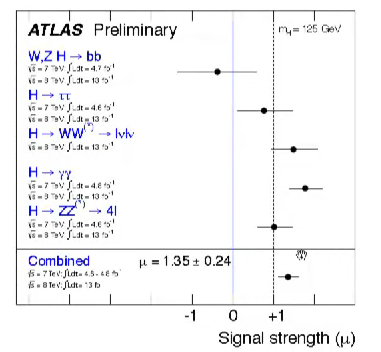
The money plots from ATLAS and CMS summarize it all:

We're seeing the Higgs in more and more channels, and the observed rates are driven, as if by magic, to  the vertical line denoting the standard model rate. 

It came to a point where the most exciting thing about the new Higgs release was what wasn't there :-) It is difficult not to notice that the easy Higgs search channels, h→γγ and ATLAS h→ZZ→4l,    were not updated.  In ATLAS, the reason was the discrepancy between the Higgs masses measured in  those 2 channels: the best fit mass came out 123.5 GeV in the  h→ZZ→4l, and 126.5 GeV in the  h→γγ channel. The difference is larger than the estimated mass resolution, therefore ATLAS decided to postpone the update in order to carefully investigate the problem.  On the other hand in CMS, after unblinding the new analysis in the h→γγ channel, the signal strength went down by more than they were comfortable with; in particular the new results are not very consistent with what was presented on the 4th of July. Most likely, all these analyses will be released before the end of the year, after more cross-checking is done.


Among the things that were there, the biggest news is the h→ττ decay. Last summer there were some hints that the ττ  channel might be suppressed, as the CMS exclusion limit was reaching the standard model rate. It seems that the bug in the code has been corrected:  CMS, and also ATLAS, now observe an excess of events over the non-Higgs backgrounds consistent with what we expect from the standard model Higgs.  The excess is not enough to claim observation of this particular decay, but enough to suppress the hopes that some interesting physics is lurking here. 

Another important update concerns the h→bb decay, for the Higgs produced together with a  W or Z boson. Here, in contrast, earlier  hints from the Tevatron suggested that the rate might be enhanced by a factor of 2 or so. The LHC experiments are now at the point of surpassing the Tevatron sensitivity in that channel, and they don't see any enhancement: CMS observes the rate slightly above the standard model one (though again, the excess is not enough to claim observation), while ATLAS sees a large negative fluctuation. Also, the Tevatron has revised downward the reported signal strength, now that they know it should be smaller.  So, again, it's "move on folks, nothing to see here"...

What does this all mean for new physics? If one goes beyond the standard model, the Higgs couplings to matter can take in principle arbitrary values, and the LHC measurements can be interpreted as constraints on these coupling. As it is difficult to plot a multi-dimensional parameter space, for presentation purposes one makes simplifying assumptions.  One common ansatz is to assume that all tree-level Higgs couplings to gauge bosons get rescaled by a factor cV, and all couplings to fermions get rescaled by an independent factor cf.  The standard model corresponds to the point cf=cV=1. Every Higgs measurement selects a preferred region in the  cV-cf parameter space, and measurements in different channels constrain different combinations of cV and cf.  The plot on the right shows 1-sigma bands corresponding to individual decay channels, and the 68%CL and 99%CL preferred regions after combining all LHC Higgs measurements. At the end of the day,  the standard model agrees well with the data. There is however a lower χ2 minimum in the region of the parameter space where the relative sign between the Higgs couplings to gauge bosons and to fermions  is flipped. The sign does not matter for most of the measurements, except in the h→γγ channel. The reason is that h→γγ is dominated by two  1-loop processes, one with the W boson and one with the top quark in the loop. Flipping the sign changes the interference between these two processes from destructive to constructive, the latter leading to an enhancement of the h→γγ rate in agreement with observations. On the down side, I'm not aware of any model where the flipped sign would come out naturally (and anyway the h→γγ will  go down after CMS updates h→γγ, probably erasing the preference for the non-SM minimum).

Finally,  we learned at the HCP that the LHC is taking precision Higgs measurements to a new level, probing not only the production rates but also more intricate properties of the Higgs signal. In particular,  CMS presented an analysis of the data in the h→ZZ→4l channel that discriminates between a scalar and a pseudoscalar particle. What this really means is that they discriminate between 2 operators allowing a decay of  the Higgs into Z bosons: 

The first operator occurs in the standard model at tree level, and leads to a preference for decays into  longitudinally polarized Z bosons. The other is the lowest order coupling possible for a pseudoscalar, and leads to decays into transversely polarized Z bosons only. By looking at the angular distributions of the leptons from Z decays (a transverse Z prefers to emit leptons along the direction of motion, while a longitudinal Z - perpendicularly to the direction of motion) one can determine the relative amount of transverse and longitudinal Z bosons in the Higgs sample, and thus discriminate between the two operators.  CMS observes a slight 2.5 sigma preference for the standard model operator, which is of course not surprising (it'd be hard to understand why the  h→ZZ rate is so close to the standard model one if the other operator was responsible for the decay). With more data we will obtain more meaningful constraints on the higher dimensional couplings of the Higgs.

To summarize,  many particle theorists were placing their bets that Higgs physics is the most likely place where new physics may show up. Unfortunately, the simplest and most boring version of the Higgs predicted by the standard model is emerging from the LHC data. It may be the right  time to start scanning job ads in condensed matter or neuroscience ;-)

All Higgs parallel session talks are here (the password is given in the dialog box).