Saturday, 31 December 2011

2011 Recap

What a year it was! It started with an earthquake, followed by rising tension. In the previous years I had to think hard to make up a decent blogging subject, this year it was enough to just sit and wait for the next breaking news. Here's a pick of the most important events in the particle world in the year 2011.

January: CDF finds new physics in tops
Measurements of the forward-backward asymmetry of the top pair production at the Tevatron have been showing interesting hints of new physics for a long time. CDF found that this asymmetry displays a very steep dependence of the energy of the colliding partons (that is on the invariant mass of the top pair) which represents a 3.4σ departure from the Standard Model predictions. Unfortunately, later on D0 did not confirm the steep mass dependence, and we need to wait more for the matter to be clarified.

April: CDF gives us goosebumps
CDF studied the invariant mass spectrum of jet pairs produced in association with a W boson, and found a bump near the 150 GeV dijet mass. After the subsequent update, the significance of the bump exceeded 4σ. It would be a clear evidence of new physics if not for the evil D0 who did not find any bump in their data. The origin of the bump will probably remain a mystery forever, much like the Roswell incident, because the Tevatron management is not very determined to resolve it.

April: Xenon100 does not find dark matter
Dark matter searches gain sensitivity at an impressive pace. Xenon100, currently the most sensitive detector for the vanilla dark matter particles, published the results based on the first 100 days of running. No luck so far. As a consolation, for each experiment that does not find dark matter there is one that does; this year CRESST joined the latter club, while CoGeNT announced an annual modulation of its detection rate. In any case, the hunt continues, it will take several more years before we may conclude we're looking in the wrong place.

April: Red Higgs Alarm
It was the first Higgs alarm this year: an internal ATLAS memo leaked to a blog was claiming a 4σ evidence for a 115 GeV Higgs in the γγ channel. The second time the alarm buzzed was after the EPS conference, when the unpublished combination of ATLAS and CMS was showing nearly 4σ evidence for a Higgs around 145 GeV. In both cases the evidence was quickly washed away by more data from the LHC. One positive thing we learned is that in the digital era collaboration secrecy is moot :-)

Summer: LHC bites deep into new territory
Around the EPS and Lepton-Photon conferences the LHC presented a number of new physics searches based on 1 inverse femtobarn of data. Alas, nothing exciting was found. SUSY, at least in its simplest incarnations, is being pushed above 1 TeV. And so are extra dimensions, technicolor, Z primes, dijet resonances, and any broader scenario that is not stealthy by design. Cold sweat is running down the backs of particle theorists...

September: OPERA goes superluminal
The OPERA collaboration stunned the world announcing that neutrinos produced at CERN arrive to their detector in Gran Sasso about 60 nanoseconds earlier than expected if they traveled at the speed of light. However the physics community remains unconvinced. There is indeed a number of very strong phenomenological and theoretical arguments that the OPERA result cannot be right. What do I think? At first I thought the pulse shape was the culprit, but that criticism was subsequently addressed by repeating the measurement with 3 nanosecond pulses. Now I think they should patent their set-up as a GPS synchronization tool :-)

September: US pulls the plug on Tevatron
It was like seeing an old dog put to death: you know it's for the better, but still it feels so sad. Of course, the Tevatron has not said the final word yet; we're still waiting for the collaborations to analyze the full data set. But the number of searches where the Tevatron can compete with the LHC is shrinking rapidly...
November: LHCb finds CP violation in charm
LHCb found that decays of D mesons into π+π- and K+K- violate the CP symmetry (at least one of them). We have seen CP violation in the K and B meson sectors, but the LHCb result was a big surprise: there was a lore that discovering CP violation in the charm meson sector at the 1% level would be a clear sign of new physics (although that is no longer so clear). Whatever it is, we learned something new about the world...

December: LHC glimpses Higgs
Higgs has been finally cornered and we think we're seeing the tip of his hat. Both ATLAS and CMS observe an excess of events in the γγ, ZZ and WW channels consistent with a Higgs boson of mass around 125 GeV. To be continued and ultimately resolved in 2012.

So raise your glasses, this one's over. According to the Mayans, the year 2o12 will be a bit shorter, but it shouldn't be less eventful ;-)

Monday, 19 December 2011

Sleeping with the Higgs

All my life the Higgs was sort of a legend. Something like a unicorn: you know well how it's supposed to look like but you don't seriously expect to see it. Since last week it feels different. Of course, everybody from the CERN DG to common bloggers justly calls for caution and not jumping to conclusions. Of course, we've seen much larger excesses go away. Of course, there is statistics, likelihoods, look-elsewhere effects, and other attributes of civilization. But there's also the good old hunch. The latter, after digesting the totality of ATLAS and CMS findings, tells me there's about a 90% chance that the Higgs exists in the mass range 124-126 GeV. This high estimate follows from the remarkable consistency of the signal between ATLAS and CMS, and between different search channels. Moreover, that mass neatly fits into the ballpark suggested by electroweak precision fits. Last not least, most of the remaining Higgs mass range is either excluded or disfavored, except maybe around 119 GeV. In other words, I don't care much about the look-elsewhere correction because there isn't any elsewhere to speak of.

Thus, I'm slowly getting used to the idea of the Higgs becoming flesh and bones. On one hand this gives me thrills, as one of the greatest mystery of the universe is being solved in front of our eyes. At the same time I can see dark clouds at the horizon. There has been a well-founded hope that the Higgs would show some unexpected properties, thus opening us the doors to new physics. In the end, it would not make sense if a theoretical concept put forward 40+ years ago showed up in Nature in precisely the predicted form, would it? Yet what ATLAS and CMS are seeing looks dangerously close to the Standard Model Higgs: the signal is showing up everywhere it should, and with roughly the size it should. Of course (now this is a serious of course) we're in no position yet to make any quantitative statements about the properties of the Higgs. Indeed, measuring the couplings of the Higgs to matter will be the clue of the experimental particle physics program for the next 20 years. The more precisely we'll measure these couplings, the bigger chance there is to catch a glimpse of new physics. Still, it is getting more likely than ever that the Standard Model is the correct description of physics at the TeV energies. This is dubbed the nightmare scenario; in the first place a nightmare for particle theorists who become expendable, but in a 30 years perspective also a nightmare for the entire particle physics program. Before the start of the LHC I was giving the nightmare scenario a 50% chance. It's more than that now. Once the Higgs is formally discovered and it fits the Standard Model one... I'm getting cold shivers just thinking about it...

PS. Regardless, isn't it a beauty ;-)

Tuesday, 13 December 2011

Visual on Higgs

Today CERN presented the latest Higgs search results. But, first things first. The live podcast of the seminar was stalling, choking, or breaking down completely. Well into the 21st century a huge international lab doing cutting edge science (and boasting of inventing the world wide web) is unable to provide a smooth transmission of its most important public presentation of the year. One may call it ironic, or repeat Didier Drogba's famous words after the 2009 Champions League semi-finals.

OK, after venting my anger I can talk some physics.
  • The main news, correctly rumored on blogs before, is that there is a significant excess of Higgs-like events corresponding to the Higgs mass of ~125 GeV. More precisely, the local significance of the ATLAS excess is 3.6σ, or 2.5σ sigma when the "look-elsewhere effect" in the 110-146 GeV mass range is taken into account. For the CMS the significance is somewhat smaller: 2.6/1.9 with/without the look-elsewhere effect. Separately, these excesses would be shrugged off; combined, they are very suggestive that we're seeing the real thing at last.


  • In ATLAS, only the H→γγ and H→ZZ*→2l+2l- channel have been updated with the full 2011 dataset. Those are the ones where statistics is limited due to the small Higgs branching fractions. However, in these final states the 4-momentum of the Higgs can be fully reconstructed to a good precision, offering a very good mass resolution of order 2 GeV. CMS updated all main channels, also those that do not provide a lot of mileage near 125 GeV at this point.
  • The excess is seen by both experiments and in each of these channels. The excess in H→γγ peaks around 124 GeV it CMS, and around 126 GeV in ATLAS, which I guess is perfectly consistent within resolution. In the 4-lepton channel, ATLAS has 3 events just below 125 GeV, while CMS has 2 events just above 125 GeV. On top of that there's the long-standing excess in the H→WW*→l+l-2ν channel, which however is not the driving force anymore. It's is precisely this overall consistency that makes the signal so tantalizing.


  • ATLAS observes slightly more events than expected from the Standard Model Higgs at that mass. In ATLAS the best fit to the Higgs cross section corresponds to roughly 1.5 the Standard Model value. Thus, one way or another, the 125 GeV thing is a fluke. It may have been good luck if these events are due to Higgs, or bad luck if they are due to other Standard Model backgrounds...


  • CMS now excludes Higgs down to 127 GeV. The ATLAS limits slightly worse around 130 GeV, but thanks to lucky background fluctuations they happened to exclude the low mass region between 112.7 and 115.5 GeV. The latter is a spectacular confirmation that what the ALEPH experiment saw back in 2001 was a genuine fundon (fundons are elementary particles produced in high-energy collider near the end of the budgetary cycle).
So much for now. The ATLAS and CMS combination notes are already out.

Monday, 12 December 2011

Tinker Taylor Soldier Higgs

Tomorrow the ATLAS and CMS experiments will reveal new results of the Higgs search based on the full 2011 dataset. The date of the presentation was not chosen accidentally: December 13 is the anniversary of the capture of Saddam Hussein. Is this suggesting that tomorrow we'll see another notorious fugitive dragged out of its hole?

Two things are 100% certain because they appeared in an official statement from CERN:
  1. Neither experiment will announce the discovery of the Higgs, in the sense of a signal with a significance of 5 sigma.
  2. Neither experiment will exclude the Standard Model Higgs over the whole low-mass range.
The rest of the story can be to a good approximation reconstructed from blogs, facebook status updates, whispers in the corridors and coffee rooms, drafts mistakenly left on printers, microfilms smuggled in diplomatic mail, etc. The story that emerges can be summarized as follows:
  • The Standard Model Higgs boson is excluded down to approximately 130 GeV, but not below.
  • As already reported widely on blogs, both experiments have an excess of events consistent with the Higgs particle of mass around 125 GeV.
  • The excess is larger at ATLAS, where it is driven by the H→γγ channel, and supported by 3 events reconstructed in the H→ZZ*→4l channel at that mass. The combined significance is around 3 sigma, the precise number depending on statistical methods used, in particular on how one includes the look-elsewhere-effect.
  • CMS has a smaller excess at 125 GeV, mainly in the H→γγ channel. They have 3 events in H→4l as well, but they are oddly shifted to somewhat lower masses of order 119 GeV. All in all, the significance at 125 GeV in CMS is only around 2 sigma.
  • With some good faith, one could cherish other 2-sigmish bumps in the γγ channel, notably around 140 GeV. Those definitely cannot be the signal of the Standard Model Higgs, but could well be due to Higgs-like particles in various extensions of the Standard Model.
Stay tuned, in about 24 hours we'll know everything there is to know. More in-depth interpretations of the ATLAS and CMS findings depend on the quantitative details of the results, in particular, to what extent the signals in various channels are consistent between the 2 experiments and with the predictions based on the Standard Model Higgs. There is a good chance we're finally looking at the real thing, I'd say 50% based on the data alone and 80% adding our sincere convictions that Higgs must really be in that mass range. However, one should not forget that last summer the combination of ATLAS and CMS 1 fb-1 results was showing an excess corresponding to a ~145 GeV Higgs with the significance as large as 4 sigma, which was blown away when more data arrived.

You're of course welcome to fill in more details or paste an excerpt of the ATLAS or CMS draft into the comment section ;-)

Friday, 2 December 2011

Update on CP violation in charm

This post came out a bit cryptic. Don't even start if you're not a huge fan of flavor physics.

There's been some new developments since 2 weeks ago when LHCb came out with the evidence of CP violation in the charm meson sector. Recall that LHCb studied the D-meson decay to π+π- and K+K- meson pairs. The observable of interest was the asymmetry of D- and anti-D-meson decay rates to these final states, A(π+π-) and A(K+K-). A non-zero value of any of these two asymmetries signals CP violation (particle and anti-particle decay rates to the same CP eigenstate being different). LHCb found that the difference ΔA = A(K+K-) - A(π+π-) is (-0.82±0.24)%, which means that, with large confidence, at least one of these asymmetries is non-zero.

The most pressing question is whether the LHCb result implies new physics? Experts emphatically agree that the answer is definitely maybe. From the existing literature one can learn that "...CP violation from new physics must be playing a role if an asymmetry is observed with present experimental sensitivities O(1%)", and "...observation of CP violation in the decay of D mesons will not necessarily be a signal of new physics...". Now, a paper from last week makes a reassessment of the Standard Model predictions and clarifies the LHCb result may or may not signal new physics.

The problem is that we are lacking reliable methods to compute processes involving D mesons. Normally, when dealing with heavy flavored mesons, one employs an effective theory where the heavy Standard Model and possibly new physics particles have been integrated out, leaving effective 4-quark interactions. This allows one to compute observables at the leading order in the expansion in powers of (1 GeV/m_quark), the former being the typical scale for QCD effects, and the latter the suppression scale of higher-dimensional operators. That is a decent expansion parameter for bottom quarks, but not so much for charm quarks. Now, ignoring that convergence issue and taking the leading order predictions at face value one arrives at the estimate ΔA∼0.1%, well below the value measured by LHCb. The new paper by Brod et al. attempts to estimate the contribution of the higher order operators to the asymmetry, using some guidance from other experimental data on D-mesons. For example, one finds that the branching fraction for D0 → K0 K0bar, which receives contributions only at next-to-leading order in 1/mc, is about five times smaller than the branching fraction of D0 → K+ K-, which received leading order contributions. That means that the respective amplitudes differ only by a factor of two, which in turn proves that the higher order 1/mc contributions can be significant. Taking that into account, the paper concludes that the Standard Model can account for |ΔA| as large as 0.4%, uncomfortably close to the LHCb measurement.

Another last week paper takes a less pessimistic approach. It simply assumes that the asymmetry measured by LHCb is dominated by new physics and attempts to understand constraints on the underlying model. In the language of effective theory, to explain the LHCb result one needs to include a ΔC =1 four-quark operator (with 1 charm and 3 light quarks, [sbar Γ c][ubar Γ s]). There are many possibilities differing by the structure of Lorentz and color indices that lead to the same observable asymmetry. The scale suppressing this higher dimensional operator should be of order 10 TeV to match to the LHCb result. This is actually a very small suppression. From non-observation of CP violation in D meson mixing we know that the scale suppressing generic ΔC=2 4-quark operators (with 2 charm and 2 light quarks) must be close to 10 000 TeV. On the other hand, once a ΔC=1 operator is present, ΔC=2 ones will necessarily be generated by loop corrections. This means that a random new physics model explaining the LHCb result will be in conflict with the data on D-meson mixing. However, the paper by Isidori et al. concludes that a subset of the ΔC=1 operators explaining the LHCb asymmetry is consistent with all other experimental data. In particular, the ΔC=1 operators involving only right-handed quarks are not excluded by the data on D-meson mixing and on direct CP violation in kaon decays (ε'/ε in the flavor jargon).

Finally, a small experimental update. CDF posted on arXiv a new paper that is similar to the earlier public note but contains one bonus track. The known result is the separate CP asymmetries D-meson decays to pions and kaons:
A(K+K-) = -0.24 ± 0.24 A(π+π-) = 0.22 ± 0.26
The bonus is that they did the subtraction and also present the difference of the asymmetries:
ΔA = -0.46 ± 0.33
which can be directly compared to the LHCb result. The CDF asymmetry difference is perfectly consistent with the LHCb one, and it's also consistent with zero. This is a hint that the true asymmetry difference is probably at a lower end of the range suggested by the LHCb measurement, and therefore closer to the Standard Model prediction. One more point for the Standard Model, but the game is not over yet.

Friday, 18 November 2011

New Higgs combination is out

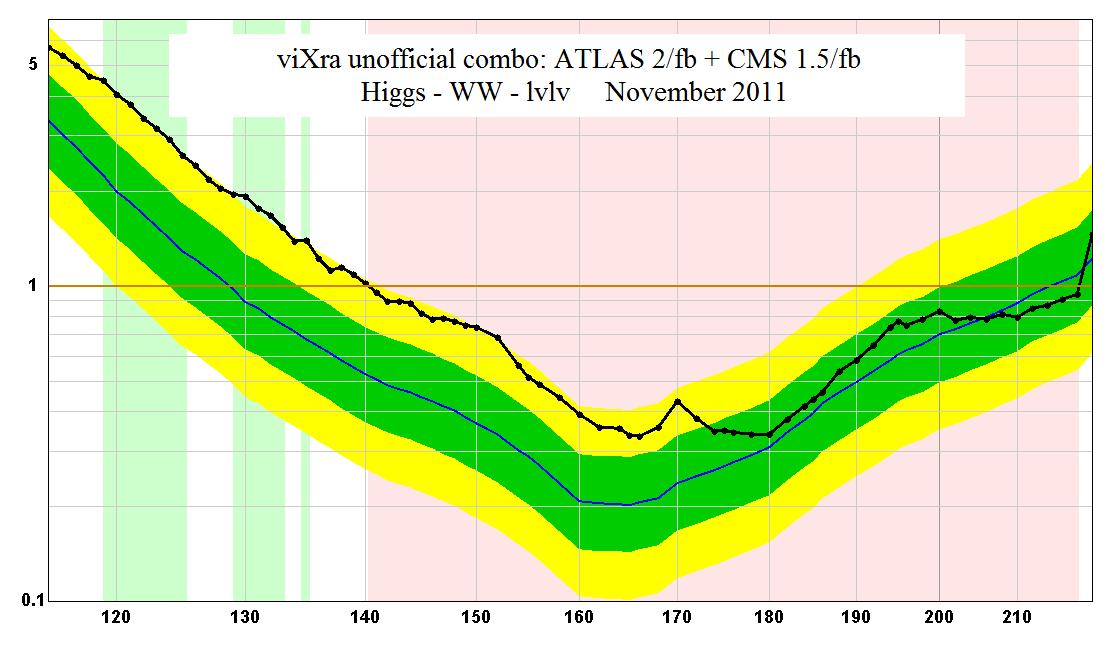
Here is a brief report about the long-awaited combination of the ATLAS and CMS Higgs search results using about 2 inverse femtobarn of data collected last summer. Overshadowed by faster-than-light neutrinos, that result was presented today at the HCP conference in Paris. It had been expected with as much thrill as results of parliamentary elections in the former Soviet Union. Indeed, in this fast-moving world 2 months ago is infinite past. Today particle physicists are rather busy rumoring the results based on the entire LHC data set of 5 inverse femtobarn. Moreover, the combined limits had not been difficult to guess, and a reasonable approximation of the official combination had been long available via viXra log.

Nevertheless, it's the chronicler's duty to report: the Standard Model Higgs is excluded at 95% confidence level for all masses between 141 GeV and 476 GeV.

Meanwhile, ATLAS and CMS have already had the first look at the full data set. Continuing the Soviet analogy, an uneasy rumor is starting among the working class and the lower-ranked party officials. Is the first secretary dead? Or on life support? Or, if he's all right, why he's not showing in public? We expect an official update for the 21st Congress of the Communist Party, sorry, the December CERN Council week. And wild speculations on Twitter well before that :-)

See the public note for more details about the combination.

Monday, 14 November 2011

LHCb has evidence of new physics! Maybe.

It finally happened: we have the first official claim of new physics at the LHC. Amusingly, it comes not from ATLAS or CMS, but from LHCb, a smaller collaboration focused on studying processes with hadrons formed by b- and c-quarks. Physics of heavy quark flavors is a subject for botanists and, if I only could, I would never mention it on this blog. Indeed, a mere thought of the humongous number of b- and c-hadrons and of their possible decay chains gives me migraines. Moreover, all this physics is customarily wrapped up in a cryptic notation such that only the chosen few can decipher the message. Unfortunately, one cannot completely ignore flavor physics because it may be sensitive to new particles beyond the Standard Model, even very heavy ones. This is especially true for CP-violating observables because, compared to small Standard Model contributions, new physics contributions may easily stand out.

So, the news of the day is that LHCb observed direct CP violation in neutral D-meson decays. More precisely, using 0.58 fb-1 of data they measured the difference of time-integrated CP asymmetries of D→ π+π- and D→ K+K- decays. The result is
3.5 sigma away from the Standard Model prediction which is approximately zero!

Here is an explanation in a slightly more human language:
  • Much like b-quarks, c-quarks can form relatively long-lived mesons (quark-antiquark bound states) with lighter quarks. Since mesons containing a b-quark are called B-mesons, those containing a c-quark are, logically, called D-mesons. Among these are 2 electrically neutral mesons: D0 = charm + anti-up quark, and D0bar = anti-charm + up cbar-u quark. CP symmetry relates particles and anti-particles, in this case it relates D0 and D0bar. Note that D0 and D0bar mix, that is they can turn into one another; this is an important and experimentally established phenomenon which in general may be related to CP violation however in the present story it plays a lesser role .
  • D-mesons are produced at the LHC with a huge cross-section of a few milibarns. LHCb is especially well equipped to identify and study them. In particular, they can easily tell kaons from pions thanks to their Cherenkov sub-detector.
  • Here we are interested in D mesons decays to a CP invariant final state f+f- where f = π,K. Thus, the D0 → f+f- and D0bar → f+f- processes are related by a CP transformation, and we can define the CP asymmetry as
    If CP was an exact symmetry of the universe, the asymmetries defined above would be zero: the decay probabilities into pions/kaons of D0 and D0bar would be the same. The Standard Model does violate CP, however its contributions are estimated to be very small in this case, as I explain in the following.
  • At the Tevatron and B-factories they measured separate measurements of the asymmetries A_CP(π+π-) and A_CP(K+K-) (obtaining results consistent with zero). LHCb quotes only the difference A_CP(K+K-) - A_CP(π+π-) because, at a proton-proton collider, the D0 and D0bar mesons are produced at a different rate. That introduces a spurious asymmetry at the detection level which, fortunately, cancels out in the difference. Besides, the mixing contribution to the asymmetry approximately cancels out in the difference as well. Thus, the observable measured by LHCb is sensitive to so-called direct CP violation (as opposed to indirect CP violation that proceeds via meson-antimeson mixing).
  • LHCb has collected 1.1 inverse femtobarn (fb-1) of data, 5 times less than ATLAS and CMS, because the LHCb detector cannot handle as large luminosity. The present analysis uses a half of the available data set. The error of the measurement is still dominated by statistics, so analyzing the full data set will shrink the error by at least Sqrt[2].
  • What does the good old Standard Model has to say about these asymmetries? First of all, any CP asymmetry has to arise from interference between 2 different amplitudes entering with different complex phases. In the Standard Model the 2 dominant amplitudes are:
    #1: Tree-level weak decay amplitude. The pictured amplitude involves the CKM matrix elements V_us and V_cs, therefore it is suppressed by one power of Cabibbo angle, the parameter whose approximate value is 0.2.
    #2: One-loop amplitude which, for reasons that should be kept secret from children, is called the penguin. Again it involves the CKM matrix elements V_us and V_cs, and also a loop suppression factor α_strong/π. However, as is well known, any CP violation in the Standard Model has to involve the 3rd generation quarks, in this case a virtual b-quark in the loop entering via V_cb and V_ub CKM matrix elements.
    The corresponding D0 → π+π- amplitudes are of the same order of magnitude.
  • All in all, the direct CP asymmetry in the D0 → π+π- and D0 → K+K- is parametrically proportional to (α_strong/π) (Vcb*Vub)/(Vus*Vcs) which is suppressed by the 4-th power of the Cabibbo angle and a loop factor. This huge suppression factor leads to an estimate of the Standard Model contribution to the CP asymmetry at the level of 0.01-0.1%. On the other hand, LHCb finds a much larger magnitude of the asymmetry, of order 1%.
  • Is it obviously new physics? Experts are not sure because D-mesons are filthy bastards. With the masses around 2 GeV, they sit precisely in the no man's land between perturbative QCD (valid at energies >> GeV) and low-energy chiral perturbation theory (valid between 100 MeV and 1 GeV). For this reason, making precise Standard Model predictions in the D-meson sector is notoriously difficult. It might well be that the above estimates are too naive, for example the penguin diagram may be enhanced by non-calculable QCD effects by a much-larger-than-expected factor.
  • And what is it if it indeed is new physics beyond the Standard Model? This was definitely not the most expected place where theorists had expected new physics to show up. Currently there are almost no models on the market that predict CP violation in D0 decays without violating other constraints. I'm aware of one that uses squark-gluino loops to enhance the penguin, let me know about other examples. This gap will surely be filled in the coming weeks, and I will provide an update once new interesting examples are out.
So, is this new physics or the Standard Model? The LHCb result is definitely exciting, but the jury is still out. This time we need not only more data, but also a more inspired approach to understand the Standard Model predictions. Let's see what theorists will make of it. The only certain thing is that it's the first evidence of CP violation in the charm sector.For more insight see also Sean, Alexey, Tommaso. Thanks to Diego for enlightenment.