Friday, 18 November 2011

New Higgs combination is out

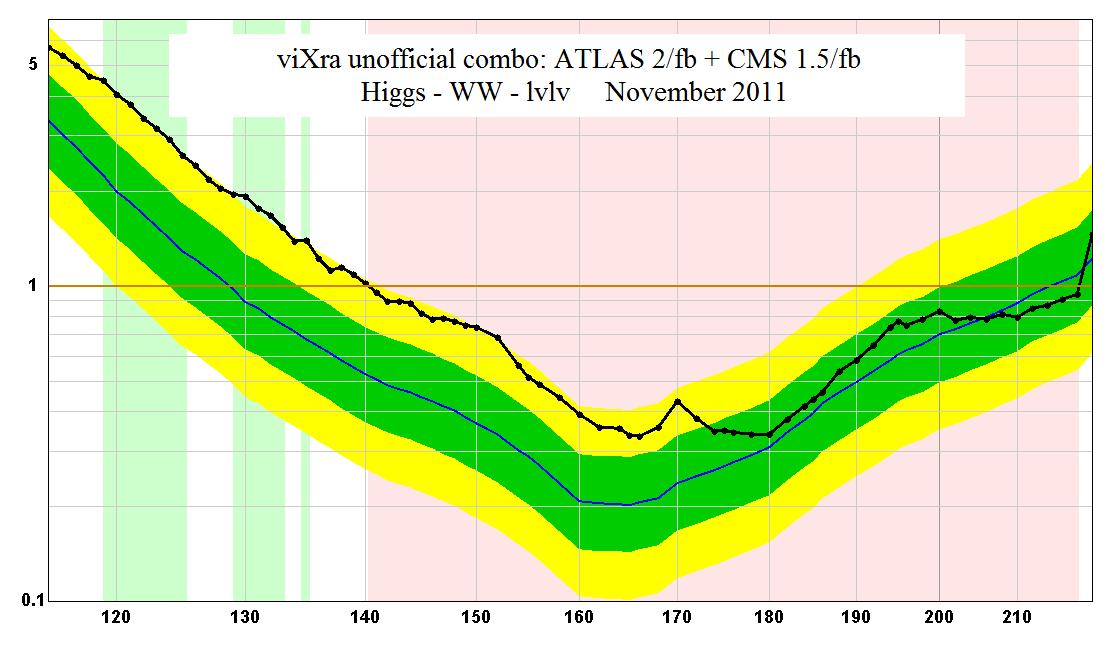
Here is a brief report about the long-awaited combination of the ATLAS and CMS Higgs search results using about 2 inverse femtobarn of data collected last summer. Overshadowed by faster-than-light neutrinos, that result was presented today at the HCP conference in Paris. It had been expected with as much thrill as results of parliamentary elections in the former Soviet Union. Indeed, in this fast-moving world 2 months ago is infinite past. Today particle physicists are rather busy rumoring the results based on the entire LHC data set of 5 inverse femtobarn. Moreover, the combined limits had not been difficult to guess, and a reasonable approximation of the official combination had been long available via viXra log.

Nevertheless, it's the chronicler's duty to report: the Standard Model Higgs is excluded at 95% confidence level for all masses between 141 GeV and 476 GeV.

Meanwhile, ATLAS and CMS have already had the first look at the full data set. Continuing the Soviet analogy, an uneasy rumor is starting among the working class and the lower-ranked party officials. Is the first secretary dead? Or on life support? Or, if he's all right, why he's not showing in public? We expect an official update for the 21st Congress of the Communist Party, sorry, the December CERN Council week. And wild speculations on Twitter well before that :-)

See the public note for more details about the combination.

Monday, 14 November 2011

LHCb has evidence of new physics! Maybe.

It finally happened: we have the first official claim of new physics at the LHC. Amusingly, it comes not from ATLAS or CMS, but from LHCb, a smaller collaboration focused on studying processes with hadrons formed by b- and c-quarks. Physics of heavy quark flavors is a subject for botanists and, if I only could, I would never mention it on this blog. Indeed, a mere thought of the humongous number of b- and c-hadrons and of their possible decay chains gives me migraines. Moreover, all this physics is customarily wrapped up in a cryptic notation such that only the chosen few can decipher the message. Unfortunately, one cannot completely ignore flavor physics because it may be sensitive to new particles beyond the Standard Model, even very heavy ones. This is especially true for CP-violating observables because, compared to small Standard Model contributions, new physics contributions may easily stand out.

So, the news of the day is that LHCb observed direct CP violation in neutral D-meson decays. More precisely, using 0.58 fb-1 of data they measured the difference of time-integrated CP asymmetries of D→ π+π- and D→ K+K- decays. The result is
3.5 sigma away from the Standard Model prediction which is approximately zero!

Here is an explanation in a slightly more human language:
  • Much like b-quarks, c-quarks can form relatively long-lived mesons (quark-antiquark bound states) with lighter quarks. Since mesons containing a b-quark are called B-mesons, those containing a c-quark are, logically, called D-mesons. Among these are 2 electrically neutral mesons: D0 = charm + anti-up quark, and D0bar = anti-charm + up cbar-u quark. CP symmetry relates particles and anti-particles, in this case it relates D0 and D0bar. Note that D0 and D0bar mix, that is they can turn into one another; this is an important and experimentally established phenomenon which in general may be related to CP violation however in the present story it plays a lesser role .
  • D-mesons are produced at the LHC with a huge cross-section of a few milibarns. LHCb is especially well equipped to identify and study them. In particular, they can easily tell kaons from pions thanks to their Cherenkov sub-detector.
  • Here we are interested in D mesons decays to a CP invariant final state f+f- where f = π,K. Thus, the D0 → f+f- and D0bar → f+f- processes are related by a CP transformation, and we can define the CP asymmetry as
    If CP was an exact symmetry of the universe, the asymmetries defined above would be zero: the decay probabilities into pions/kaons of D0 and D0bar would be the same. The Standard Model does violate CP, however its contributions are estimated to be very small in this case, as I explain in the following.
  • At the Tevatron and B-factories they measured separate measurements of the asymmetries A_CP(π+π-) and A_CP(K+K-) (obtaining results consistent with zero). LHCb quotes only the difference A_CP(K+K-) - A_CP(π+π-) because, at a proton-proton collider, the D0 and D0bar mesons are produced at a different rate. That introduces a spurious asymmetry at the detection level which, fortunately, cancels out in the difference. Besides, the mixing contribution to the asymmetry approximately cancels out in the difference as well. Thus, the observable measured by LHCb is sensitive to so-called direct CP violation (as opposed to indirect CP violation that proceeds via meson-antimeson mixing).
  • LHCb has collected 1.1 inverse femtobarn (fb-1) of data, 5 times less than ATLAS and CMS, because the LHCb detector cannot handle as large luminosity. The present analysis uses a half of the available data set. The error of the measurement is still dominated by statistics, so analyzing the full data set will shrink the error by at least Sqrt[2].
  • What does the good old Standard Model has to say about these asymmetries? First of all, any CP asymmetry has to arise from interference between 2 different amplitudes entering with different complex phases. In the Standard Model the 2 dominant amplitudes are:
    #1: Tree-level weak decay amplitude. The pictured amplitude involves the CKM matrix elements V_us and V_cs, therefore it is suppressed by one power of Cabibbo angle, the parameter whose approximate value is 0.2.
    #2: One-loop amplitude which, for reasons that should be kept secret from children, is called the penguin. Again it involves the CKM matrix elements V_us and V_cs, and also a loop suppression factor α_strong/π. However, as is well known, any CP violation in the Standard Model has to involve the 3rd generation quarks, in this case a virtual b-quark in the loop entering via V_cb and V_ub CKM matrix elements.
    The corresponding D0 → π+π- amplitudes are of the same order of magnitude.
  • All in all, the direct CP asymmetry in the D0 → π+π- and D0 → K+K- is parametrically proportional to (α_strong/π) (Vcb*Vub)/(Vus*Vcs) which is suppressed by the 4-th power of the Cabibbo angle and a loop factor. This huge suppression factor leads to an estimate of the Standard Model contribution to the CP asymmetry at the level of 0.01-0.1%. On the other hand, LHCb finds a much larger magnitude of the asymmetry, of order 1%.
  • Is it obviously new physics? Experts are not sure because D-mesons are filthy bastards. With the masses around 2 GeV, they sit precisely in the no man's land between perturbative QCD (valid at energies >> GeV) and low-energy chiral perturbation theory (valid between 100 MeV and 1 GeV). For this reason, making precise Standard Model predictions in the D-meson sector is notoriously difficult. It might well be that the above estimates are too naive, for example the penguin diagram may be enhanced by non-calculable QCD effects by a much-larger-than-expected factor.
  • And what is it if it indeed is new physics beyond the Standard Model? This was definitely not the most expected place where theorists had expected new physics to show up. Currently there are almost no models on the market that predict CP violation in D0 decays without violating other constraints. I'm aware of one that uses squark-gluino loops to enhance the penguin, let me know about other examples. This gap will surely be filled in the coming weeks, and I will provide an update once new interesting examples are out.
So, is this new physics or the Standard Model? The LHCb result is definitely exciting, but the jury is still out. This time we need not only more data, but also a more inspired approach to understand the Standard Model predictions. Let's see what theorists will make of it. The only certain thing is that it's the first evidence of CP violation in the charm sector.For more insight see also Sean, Alexey, Tommaso. Thanks to Diego for enlightenment.

Friday, 11 November 2011

Double Dare

(There's nothing like a little rant on a holiday morning)

Last Wednesday I noticed this press release from Double Chooz which announced "the observation of the disappearance of (anti-)neutrinos in the expected flux observed from the nuclear reactor" which implies "complementary and important evidence of oscillation also involving the third angle". Wow, I thought, they've nailed down theta13! But it turned out to be much more exciting than just another fundamental parameter. A more careful reading reveals that, based on the first 100 days of data, Double Chooz found sin^2(2 theta13) = 0.085 ± 0.051. Clearly something interesting is going on. To an untrained eye, the Double Chooz result is... consistent with zero; moreover it is similar, even if slightly less precise, to the null result from MINOS: sin^2(2 theta13) = 0.04 ± 0.04. However now in the 21st century one needs a more inspired approach to statistics...

To better understand what's going on, go back a few months. In June this year the T2K experiment also issued a press release about theta13, announcing "an indication that muon neutrinos are able to transform into electron neutrino". T2K is an experiment in Japan where a beam of muon neutrinos with GeV energies is produced in J-PARC and sent over a 300km tunnel ;-) to the SuperKamiokande detector. It is established that muon neutrinos can oscillate into tau neutrinos, the process being governed by the theta23 angle in the MNS neutrino mixing matrix whose value is close ot 45 degrees. If the angle theta13 in that same matrix is non-zero then the process ν_μ → ν_e is also allowed. For this reason, T2K was searching for an appearance of electron neutrino in the muon neutrino beam. The T2K announcement was based on the detection of 6 electron neutrino events, versus about 2 expected from background. At the time some of us wondered why they put such a spin on a merely 2.5 sigma excess, given that neutrino experiments had already produced many confusing results with similar or larger significance (LSND, MiniBoone, later OPERA). After all, neutrino beam experiments are plagued by difficult systematic uncertainties which are due to our incomplete understanding of the dirty hadronic physics involved in the beam production. Indeed, the subsequent results from MINOS turned out to disfavor the T2K central value of sin^2(2 theta13) of about 0.11.

In hindsight, the T2K press release was a pioneering step in data interpretation and the gauntlet was recently picked up Double Chooz. The latter experiment is targeting the transformation of anti-electron neutrinos into other type which, at short distances, is also controlled by the theta13 angle. More precisely, Double Chooz is looking for disappearance of MeV anti-electron neutrinos at a distance of 1 km away from the French nuclear reactor Chooz B where the antineutrinos are produced. They observe a small deficit of events in the energy range 2-5 MeV compared to the no-oscillation hypothesis, see the picture. While T2K was spinning a less-than-3-sigma excess, the Double Chooz press release made a further bold step and presented a less-than-2-sigma one as an evidence. There is still a long way to adapt the standards used in psychology and behavioral sciences. But, little by little, this approach could be applied to wider areas of physics, especially to high energy physics which suffers from dearth of discoveries. Just think of it: if we could call a 2 sigma excess an indication then every week the LHC could deliver an indication of new physics!

But, seriously... I also expect that the value of theta13 is non-zero and the experiments may be seeing the first hint of it. One argument is that global fits to the neutrino oscillation data point to sin^2(2 theta13) = 0.05 and 3 sigma away from zero. Besides, there is no compelling theoretical reason why theta13 should be zero (and if you believe in anarchy there is a reason to the contrary). The smoke should clear up in the next few years thanks to Double Chooz, Daya Bay, NOvA, and others. However the current experimental situation is far from being conclusive and the latest Double Chooz results did not change much in this respect, as can be seen in the fit to the right. I guess this could have been said without diminishing the importance of Double Chooz, and without treating the public as retarded...

See the web page of Double Chooz and this post on Quantum Diaries for more details.

Wednesday, 2 November 2011

Experimental success, theoretical debacle

(This post is an attempt to catch up with October subjects that were being trendy when I was on leave from blogging, even though I suppose no one cares anymore)

This year's Nobel prizes were by all means exceptional. In blatant disregard of noble traditions, the prize in physics was given for a groundbreaking(!) and recent(!!) discovery without omitting any of the key contributors(!!!). Indeed, the discovery of accelerated expansion is one of the greatest triumphs of modern science. The measurements of supernovae brightness in the 90s and subsequent experiments have demonstrated that the universe is currently dominated by a form of energy characterized by negative pressure. In fact, this "dark energy" has the properties of the vacuum energy aka the cosmological constant, first introduced by Einstein for completely wrong reasons. In science, experimental progress usually brings better theoretical understanding. And that's another exceptional thing about the recent Nobel: almost 15 years after, the understanding of the cosmological constant in the context of particle physics models is as good as non-existent.

The cosmological constant problem has been haunting particle physicists for nearly a century now. We know for a fact that all forms of energy gravitate, including the energy contributed by quantum corrections. Thus, we know that diagrams with a graviton coupled to matter loops, like the one in the upper picture, yield a non-vanishing contribution to scattering amplitudes. On the other hand, the sum of very similar diagrams with graviton coupled to matter loops in vacuum must be nearly zero, otherwise the approximate Minkowski vacuum in which we live in would be destabilized. The contribution of the electron loop alone (the lower picture) is about 50 orders of magnitude larger than the experimental limit. On top of that, there should be classical contributions to the vacuum energy, for example from the QCD condensate and from the Higgs potential, which are also naturally tens of orders of magnitude larger than the limit.

The usual attitude in theory is that when something is predicted infinite one assumes it must be zero, and that was a good enough approach before 1998. The discovery of accelerated expansion was a game-changer, because it experimentally proved that the vacuum energy is real and affects the cosmological evolution, therefore the problem can no longer be swiped under the carpet. In fact, the problems is now double. Not only we need to understand why the cosmological constant takes a highly unnatural value from the point of view of the effective low-energy theory (the old cosmological constant problem), but we need to understand why it is of the same order as the matter energy density today (the coincidence problem).

Neither the first nor the second problem has found a satisfactory solution to date. Not for a lack of trying. People have attacked the problem via IR and/or UV modifications of gravity, quintessence fields, self-tuning or attractor solutions, fancy brane configurations in extra dimensions, elephants standing on turtles, space-time wormholes, etc, see also the comment section for crazier examples. In vain, all these solutions either rely on theoretically uncontrollable assumptions, or they just shift the problem somewhere else. The situation remains so dramatic that there are 2 only solutions that are technically correct:
  1. The anthropic principle: the cosmological constant is an environmental quantity that takes different values in different patches of the universe, however more-or-less intelligent observers can see only those tiny patches where it is unnaturally small.
  2. The misanthropic principle: the cosmological constant is being adjusted manually by seven invisible dwarfs wearing red hats.
Both of these theories have a comparable predictive power. In the first case we currently have no way to know the fundamental theory that sets the statistical distribution of the cosmological constant. In the second case we don't know what the little bastards are really up to.

Maybe theory needs another clue that may be provide by one of the future experiments. The Planck satellite will publish an update on cosmological parameters in 2013, although the rumor is that there won't be any revolution. In the asymptotic future there is ESA's Euclid satellite who will precisely measure the distribution of dark matter and dark energy in the universe. Will I live to see the day when the problem is solved? My bet is that no, but I'd love to proven wrong...

For the best summary of the cc problem read Section 1 of Polchinki's review.

Thursday, 27 October 2011

What if they don't find the Higgs?

(...No I didn't cut my wrists after the Tevatron shutdown, contrary to what you might have concluded from my blogging history...)

So, the 2011 run of the LHC is coming to a close, I mean the interesting part ;-). A 5 inverse femtobarn stash of data has been collected by each ATLAS and CMS. These data will by fully analyzed and scrutinized by the late winter 2012, while rumors should start popping up on blogs before the end of this year. One thing that is already clear is that new physics did not jump in our faces, which is hardly a surprise. And neither did the Higgs boson, which is more intriguing. Contrary to what I expected, the 2011 data may not yield a conclusive statement about the Higgs: neither a clear cut discovery nor excluding the entire low mass range appears likely at this point. We can now at least entertain the option, which as recently as last summer was unthinkable, that the LHC will not find the Higgs particle with the properties predicted by the Standard Model. What then?

First of all, it will be fun to watch the CERN management explaining the public that *not* discovering the Higgs is a success. For theorists, on the other hand, the best of all worlds will have been granted. In fact, we already have a deck of cards to play for that occasion, each very interesting as each pointing to exciting new physics within our reach. Here are the 3 main broad scenarios (not mutually exclusive):
  • Higgs exists but has a smaller production cross section.
    In the Standard Model the Higgs is produced mostly in gluon fusion, via a loop diagram with top quarks. One can easily imagine new particles meddling into Higgs production via a similar loop process; all they need is a color charge and a significant coupling to the Higgs. Thus, in every major new physics scenario modifying the Higgs production rate is possible without stretching the parameters too much. One interesting case is the composite Higgs, where the Higgs cross section is almost always suppressed, typically down to 70-90% of the Standard Model value. For experimentalists this is the simplest scenario, all they need to do is sit and wait a bit longer, and the Higgs will eventually show up. The matter should be sorted out after the 2012 data are analyze.
  • Higgs exists but has non-standard decays.
    For a low mass Higgs, around 120 GeV, the main discovery channel is the decay into 2 photons. Again, this is a loop process in the Standard Model so it's very easy for new physics to modify the branching fraction for that decay. As in the previous case, one may just sit and wait for the Higgs to eventually show up. However Higgs decays can be easily modified in a far more dramatic fashion than the production rate. For example, Higgs may be invisible, that is decaying into very weakly interacting particles whose only signature is the unbalanced momentum in the event. Or Higgs may dominantly decay into multiparticle final states (some popular model predict decays to 4 tau leptons or 4 b-quarks) and we'll never see the bastard in the diphoton channel. That would be a very interesting scenario not only for theorists but also experimentalist, as it would require clever new methods to spot the Higgs on top of the QCD background.
  • There is no Higgs.
    That would mean that the mechanism of electroweak symmetry breaking is inherently strongly coupled, somewhat resembling breaking of the chiral symmetry in QCD. This is the most challenging scenario for theorists and experimentalists, and the one that may require a lot of patience. In the optimistic case, the 14 TeV LHC run we will spot a number of resonances analogous to QCD mesons and little by little we'll understand the structure of the underlying gauge theory. But these resonances may well be too heavy or too wide to be efficiently studied at the LHC. Ultimately, we may need to probe the properties of the scattering amplitudes of W and Z bosons where, according to theory, these strong interactions must leave an imprint. The problem is that such a measurement is very non-trivial in the dirty LHC environment (the SSC or a linear collider would be a different story), so we may need some new theoretical or experimental ideas to make the progress. It's probably too early to bet large amounts on this scenario (which is currently disfavored by electroweak precision data) but if no hint of the Higgs is seen by the end of 2012 that will become the most promising direction.
In summary, discovering the Higgs would be a big news, a huge achievement of the whole community, one small step for mankind, et cetera. But not discovering it would be more exciting by a lot, a lot, a lot. Of course, assuming that eventually we will find something ;-)

Friday, 30 September 2011

Live from Fermilab: Chronicle of a Death Foretold

2:38 pm: It's over. The heart stopped 2:38 pm, the last store number was 9158. Good night.
2:37 pm: Helen Edwards all too eagerly pressed the big red button to dump the beam. Soon she will press the big green button to ramp down.
2:35 pm: Stop Helen, I'm afraid
2:35 pm: The heart is still beating but the brain is dead: Tevatron no longer records the data.
2:34 pm: ...though I must say that the CDF show was much more entertaining.
2:32 pm: D0 run terminated. They're ramping down.
2:29 pm: Somehow the whole ceremony reminds me of this scene.
2:28 pm: Time for D0, the better of the 2 Tevatron experiments ;-) Bill Lee from the D0 control room.
2:25 pm: The CDF run has been terminated, 2 million events collected. CDF no longer takes data.
2:22 pm: There is now a story of chickenpox children sacrificed at the altar of science. You don't want to know how it ends.
2:16 pm: Ben Kilminster live from the CDF control room says that back in 1985 there was only one monitor there. There was also no blogs, Twitter or Facebook. Clearly there is some progress...
2:15 pm: Soon the detectors will start shutting down. They don't to watch it...
2:10 pm: Tour of the control room. Looks like space movies from the 70s with lots of color lights blinking.
2:o4 pm: It started. Booooo. Pier Oddone, the director of Fermilab, speaking.
2:o1 pm: Nothing's happening yet. The stream shows photos of serious faces staring at monitors or parts of the accelerator.
1:57 pm: I wonder what will happen to the buffaloes... Will they all be slaughtered and served at the funeral party in the Wilson Hall autrium?
1:50 pm: Except for the top quark, is the Tevatron going to be remember for anything? In the coming years their measurement of the top quark and the W boson mass will remain the most precise one - the LHC will have to struggle hard to beat it. Moreover, a number of measurements - especially various production asymmetries - cannot be repeated at the LHC.
1:45 pm: The Tevatron will die today but the ghost will linger on a bit longer. Physics analyses based on the full dataset are expected only in about 5 months, for the winter 2012 Moriond conference. After that the trickle will be slowing down, but papers and analyses should will be coming up for several more years.
1:40 pm: Streaming of the execution will begin in about 5 minutes.
1:30 pm: Memorial photo of the D0 collaboration in the pit. Not much time left...
1:10 pm: Dismantling of the Tevatron will begin in about a week, shutdown, as soon as the superconducting magnets are warmed up to the room temperature. The CDF detector will also be shut down today, while D0 will be operating for 3 more months to get a sample of cosmic events for calibration purposes. I'm not aware of any plans of reusing parts of these detectors for other experiments.
12:50 pm: With the shutdown of the Tevatron, Fermilab is losing its dearest child and the place at the forefront of high-energy physics, but for a while it will remain an important laboratory running smaller scale experiments. The dark matter detector COUPP, or the neutrino experiment MINOS will be producing important results that may even make it to blogs ;-) Construction of Mu2e, an interesting experiment to study lepton flavor violation, will begin in 2013. In the long run, however, the future of Fermilab looks bleak. Most likely it will share the fate of other once great US labs, like BNL or SLAC: sliding slowly into insignificance.
12:10 pm: One more statistically significant departure from the Standard Model was reported by the Tevatron: the dijet mass bump in W+2j events at CDF. Unfortunately, the effect was not confirmed by D0. It's not clear if this will be sorted out anytime soon...


12:10 pm:
The shutdown of the Tevatron should be viewed as a part of the bigger program of shutting down fundamental research in the US. It makes sense: since manufacturing could be outsourced to China, no reason why research could not.
12:05 pm: Here you can see the current status of the accelerator. The luminosity is low but the old chap should make it all the way to the end.
11:45 am: Wonder how the execution will be carried out? In the state of Illinois they do it as follows:
...Helen Edwards, who was the lead scientist for the construction of the Tevatron in the 1980s, will terminate the final store in the Tevatron by pressing a button that will activate a set of magnets that will steer the beam into the metal target. Edwards will then push a second button to power off the magnets that have been guiding beams through the Tevatron ring for 28 years...
I think there should be 3 people, each pressing a button, only one of which is actually connected to the kicker...11:40 am: It's a beautiful autumn day here in Fermilab today, unusually beautiful. Nature refuses to mourn.
11:05 am: The Tevatron has 3-4 more hours to live.
11:00 am: Except for the top asymmetry, another Tevatron's measurement returned a result grossly inconsistent with the Standard Model, namely, the dimuon charge asymmetry at D0. Although the interpretation of this result in terms of anomalous CP violation in the B-meson sector has been put to doubt by recent LHCb measurements of related processes, formally the D0 result still stands 10:45 am: The gravestone is ready even before the actual death:
10:15 am: So, Tevatron Run I got the top quark. Run II, which started in 2001, had 2 major goals: find the Higgs and find new physics. From this perspective one must admit that, \begin{evenif} insert here how great job was done \end{evenif}, Run II was a disappointment.
9:50 am: Except for the top quark, what were the most important findings of the Tevatron? See the list at Tommaso's blog.9:30am: Tevatron's observation of the anomalous top-antitop forward-backward asymmetry is currently the strongest hint that there may be new physics. The fact it is the strongest is not really encouraging ;-)
9:15am: A bit of nostalgia: a page in Particle Data Group from 1996
9:00am: The LHC is leading the game in most of the Higgs search channels, but for the moment the Tevatron has a far better sensitivity to a light Higgs boson decaying to a pair of b-quarks. Interestingly, they see no excess in this channel (the excess in the combination comes mostly from the H to WW channel), even though they should if the Higgs is there...
8:40am: The eulogies have begun. For the next 2 hours I'll listen to the summary of the most important results obtained by the D0 collaboration.
8:30am: They're still accumulating antiprotons; a sort of life support in case the Tevatron trips before the scheduled time.
8:10am: The last store of protons and antiprotons is circulating in the ring since last evening. Current luminosity: 100 ub/sec, more than 3 times below the peak luminosity. Clearly, the Tevatron is already flatlining.
8:00am: The Tevatron will go down in history as the place where back in 1995 they discovered the top quark - probably the heaviest elementary particle.
7:50am: Tevatron's first beam was in 1983 so he's dying at 28. One year more than Janis Joplin, Jimmy Hendrix, Jim Morrison, Kurt Cobain and Amy Winehouse. What's similar is that death is coming is when the career is already on the decline.
7:45am:
I'm wide awake, it's morning in Fermilab. Putting on my best suit and setting off to the funeral. In less than 7 hours the Tevatron will be no more...

Friday, 23 September 2011

The Phantom of OPERA

Those working in science are accustomed to receiving emails starting with "dear sir/madam, please look at the attached file where I'm proving einstein theory wrong". This time it's a tad more serious because the message comes from a genuine scientific collaboration... As everyone knows by now, the OPERA collaboration announced that muon neutrinos produced at CERN arrive to a detector 700 kilometers away in Gran Sasso about 60 nanoseconds earlier than expected if they traveled at the speed of light (incidentally, trains traveling the same route arrive always late). The paper is available on arXiv, and the video from the CERN seminar is here.

OPERA is an experiment who has had some bad luck in the past. Its original goal was to study neutrino oscillations by detecting the appearance of tau neutrinos in a beam of muon neutrinos. However due to construction delays their results arrive too late to have any impact on measuring the neutrino masses and mixing; other experiments have in the meantime achieved a much better sensitivity to to these parameters. Moreover, the "atmospheric" neutrino mass difference, which enters the probability of a muon neutrino oscillating into a tau one, turned out to be at the lower end of the window allowed when OPERA was being planned. As a consequence, a fairly small number of oscillation events is predicted to occur on the way to Italy, leading to the expectation of about 1-2 tau events to be recorded during experiment's lifetime (they were lucky to already get 1). However they will not walk off the stage quietly. What was meant to be a little side analysis returned the result that neutrinos travel faster than light, confounding the physics community and wreaking havoc in the mainstream media.

I'm not very original in thinking that the result is almost certainly wrong. The main experimental reason, already discussed on blogs, is the observation of neutrinos from the supernova SN1987A. Back in 1987, three different experiments detected a burst of neutrinos, all arriving within 15 seconds and 2-3 hours before the visible light (which agrees with models of supernova explosion). On the other hand, if neutrinos traveled as fast as OPERA claims, they should have arrived years earlier. Note that the argument that OPERA is dealing with muon neutrinos while supernovae produce electron ones is not valid: electron neutrinos have enough time to oscillate to other flavors on the way from the Large Magellanic Clouds. One way to reconcile OPERA with SN1987A would be to invoke a strong energy dependence of the neutrino speed (it should be steeper than Energy^2), since the detected supernova neutrinos are in the 5-40 MeV range, while the energy of the CERN-to-Gran-Sasso beam is 20 GeV on average. However OPERA does not observe any significant energy dependence of the neutrino speed, so that is an unlikely explanation either.

From the point of view of theory the chances that the OPERA result being true are no better as there is no sensible model of tachyonic neutrinos. At the same time, we've been observing neutrinos in numerous experiments and in various different settings, for example in beta decay, from terrestrial nuclear reactors, from the Sun, in colliders as missing energy, etc. Each time they seem to behave like ordinary fermions obeying all rules of the local Lorentz invariant quantum field theory.

We should weigh this evidence against the analysis of OPERA which does not appear rock solid. Recall that OPERA was conceived to observe tau neutrino appearance, not to measure the neutrino speed, and indeed there are certain aspects of the experimental set-up that call for caution. The most worrying is the fact that OPERA has no way to know the precise production time of a neutrino it detects, as it could be produced anytime during a 10 microsecond long proton pulse that creates the neutrinos at CERN. To go around this problem they need a statistical approach. Namely, they measure the time delay of the neutrino arrival in Gran Sasso with respect to the start of the proton pulse at CERN. Then they fit the time distribution to the templates based on the measured shape of the proton pulse, assuming various hypotheses about the neutrino travel time. In this manner they find that the best fit is for the travel time is 60 nanoseconds smaller than what one would expect if the neutrinos traveled at the speed of light. However, one could easily imagine that the systematic errors of this procedure have been underestimated, for example, the shape of the rise and the fall-off of the proton pulse have been inaccurately measured. OPERA does a very good job arguing that the distance from CERN to Gran Sasso can be determined to 20 cm precision, or that synchronizing the clocks in these two labs is possible to 1 nanosecond precision, but the systematic uncertainties on the shape of the proton pulse are not carefully addressed (and, during the seminar at CERN, the questions concerning this issue were the ones that confounded the speaker the most).

So what's next? Fortunately OPERA appears to be open for discussion and scrutiny, thus the issue of systematic uncertainties should be resolved in the near future. Simultaneously, the MINOS collaboration should be able to repeat the measurement with similar if no better precision, and I'm sure they're already sharpening their screwdrivers. In the longer timescale, OPERA could try to optimize the experimental setting for the velocity measurement. For example, they might install a near detector on the CERN site (where there should be no effect if the current observation is due to neutrinos traveling faster than light, or there should be a similar effect if there is an unaccounted for systematic error in the production time). Or they could use shorter proton pulses, so that the neutrino production time can be determined without statistical gymnastics (it appears feasible - the LHC currently works with 5 ns bunches). I bet, my private level of confidence being 6 sigma, that the future checks will demonstrate that neutrinos are not superluminal... in the end the character from the original book turned out to be 100% human. But, of course, the ultimate verdict belongs not to our preconceptions but to experiment.